


GIGO: When AI & Social Media Collide
Commentary & Analysis
Lately, my Facebook feed has been increasingly filled with repetitive stories, seemingly unchecked misinformation, manufactured emotional appeals, and low-substance content. Some of it is entertaining. Some is tastefully done. Others raise concerns about authenticity, misleading claims, or potentially fraudulent content. Of course, that is my observation, not a scientific finding or an allegation. As far as I know, my feed is shaped by my own interactions and Facebook's recommendation systems, which raises a whole other set of questions reserved for another day.

Wix Stock Image
Let me start this with a few distinctions before getting straight into it.
Who Are Content Creators?
Broadly, anyone who creates and publishes material on social media. For example, a Pew Research survey found 70% of U.S. adults post or share content.1 Draw your own conclusions, but if we're not limiting the definition to those who produce original content, it seems fair to say most of us qualify in some way.
I have never particularly identified with that label, though. On platforms like X and Substack, I am mostly an observer, following the day's political machinations. On professional platforms, my interests center primarily on research. But on platforms where I post more casually, I consider myself something of a hobbyist historian who enjoys researching, writing, and sharing stories that might otherwise be forgotten. But technically, I suppose I am.
Who Uses AI?
According to Adobe Newsroom, many people do.2
Adobe’s October 2025 survey included more than 16,000 creators across eight countries. Here are the results:
86% reported actively using generative AI for creative work.
55% used it for editing, upscaling, or enhancement.
52% used it to generate assets such as images and videos.
48% used it to brainstorm or develop ideas.
I use artificial intelligence, recently renamed to super intelligence, and I make no apologies for that. I use AI-enabled tools as critical reviewers to challenge my narratives, identify potential weaknesses, and help locate sources that I subsequently examine myself. Generative AI also helps me create thumbnails and occasional illustrative images when authentic historical imagery is unavailable, and I am short on time.
I use AI to support my original work, not to replace the research, critical thinking, judgment, creativity, and synthesis that make the work mine.
The difference in who is doing what is clear when we consider GIGO.
I'll explain what I mean by GIGO in a minute.
First, I will share something I believe strongly:
If you work in a profession involving information, data, finance, research, communication, marketing, digital art, or similar disciplines, learning to use AI thoughtfully may become increasingly important to your professional relevance. Some even predict jobs requiring terminal degrees may be the first to go.
But there is another side to that argument.
Learning to operate AI is not the same as developing expertise. If you rely on it to do all the intellectual heavy lifting without understanding or evaluating what it produces, you may end up with impressive-looking work you cannot adequately explain, defend, or verify.
So, why am I here questioning?
If you know me at all, you know I am a curious creature. I question almost everything. But beyond that, I am at a crossroads about whether to keep participating in this whole social media experiment. My personal Facebook account remains relatively guarded, but since June, our private company's public social media accounts have gained more than 20,000 followers and accumulated millions of views from people following my Hometown Murders & Mysteries short videos that cover a portion of the stories in the book series by the same name.
The overwhelming majority of followers have responded positively and have been an absolute pleasure to engage with and learn from. On the other hand, a minority of comments have been critical, several specifically about the use of AI.
Those comments made me think. Not the routine hater comments that were clocked early on, but the ones that expressed the appropriate level of discussion to cause me to register what they were really saying.
Some criticism seems rooted in a genuine concern about AI-generated content and authenticity. I have wondered whether some of the frustration, particularly among the up-and-coming generations, reflects broader anxieties about what AI may mean for their creative work, professional aspirations, and future employment.
Imagine preparing to enter a profession only to discover that technology is changing it faster than you can establish yourself.
I can appreciate why that might create resentment or uncertainty.
Ironically, I have received responses to prompts where my work was used without citation or reference. I'm still not sure what to do with that.
Of course, not every criticism reflects economic anxiety, and not every objection to AI is unreasonable. Legitimate questions about copyright, originality, creative ownership, and the displacement of human work deserve serious consideration.
As for those who simply enjoy being disagreeable, I suspect they could find much more interesting things to criticize me about.
But criticism of AI-generated content, combined with the changes I am seeing in my own Facebook feed and other experiences, has made me reconsider something I have encountered throughout my professional career.
GIGO: Garbage In, Garbage Out
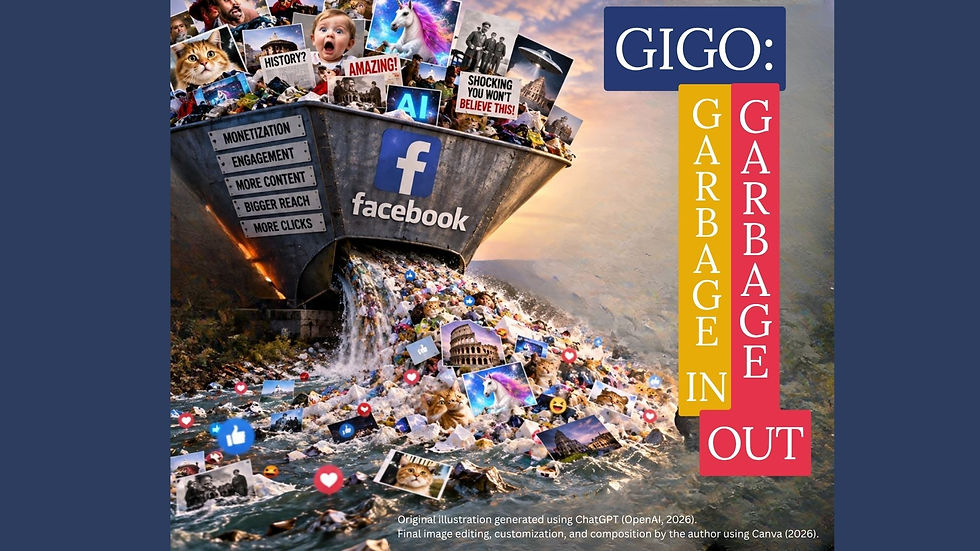
The expression originated in the early days of computing and predates generative AI by decades, but I don't know its exact origin. Even so, it describes a straightforward problem: poor-quality inputs tend to produce poor-quality outputs.
But what happens when the outputs can be generated almost instantaneously, packaged to look remarkably professional, distributed to enormous audiences, and potentially monetized regardless of their accuracy or value?
And what happens when those outputs become part of the larger information environment from which other people—and potentially other AI systems—draw information?
That is where my concern lies.
I believe AI technology has enormous potential, and I would rather see us learn to use it responsibly than watch public confidence deteriorate because of careless applications and the pursuit of clicks, shares, and revenue.
My concern is that we may be creating an environment in which producing more content is rewarded more consistently than producing meaningful content. That's my interpretation, based largely on what I have experienced and observed lately, primarily on three social networks.
But let's not take my assumption for truth. Let's see what the research says.
The Research Question
Have social-media monetization programs, combined with increasingly accessible generative AI, created an environment that rewards content production more than the quality of what is produced?
Recent research suggests legitimate reasons for concern, and the consequences may extend far beyond an increasingly irritating Facebook feed.
When Engagement Becomes the Product

Wix Stock Image
In March 2026, Meta announced that Facebook paid creators nearly $3 billion in 2025, a 35% increase from the previous year. Its expanded creator initiatives emphasized growth, qualified views, engagement, and opportunities to earn money from eligible videos, photographs, stories, and text posts.3
There is nothing inherently wrong with compensating creators. Writers, artists, educators, historians, journalists, and others invest considerable time and effort in developing material that informs, entertains, or inspires audiences.
But performance-based compensation introduces an important tension.
When financial rewards depend heavily on views, watch time, and other engagement measures, creators have an economic incentive to produce whatever attracts attention. And attention doesn't necessarily measure quality.
A carefully researched historical account might attract a few hundred interested readers, while a sensationalized or entirely fabricated version could generate thousands of reactions. An authentic historical photograph might receive less attention than an AI-generated image depicting an event that never happened. An inflammatory statement might travel farther than a measured, evidence-backed explanation.
That does not mean Facebook deliberately rewards falsehoods, nor does it establish that expanded monetization caused the deterioration I perceive. It does, however, raise a legitimate question about the relationship between the behaviors a system measures and those it ultimately encourages.
In organizational performance, we recognize the danger of treating an indicator as though it represents the entire outcome. When the measure becomes the target, people may begin optimizing for the measurement rather than the underlying purpose.
In social media, the distinction is fairly straightforward: Engagement measures what attracts attention. It does not necessarily measure what deserves attention.
Artificial Intelligence Enters the Equation

Wix Stock Image
Generative AI has dramatically lowered the cost, technical barriers, and time required to produce digital content.
And that is not necessarily a bad thing.
As I said earlier, I use AI for various tasks—reviewing the validity of the sources used in this article is one example.4 I recognize its tremendous potential for research review, brainstorming, formatting, creative development, education, historical interpretation, and communication. Someone without graphic-design training can develop compelling imagery. A writer can use AI to explore narrative structures, identify weaknesses in a draft, or organize complicated information. Small organizations can produce materials that previously required considerably greater resources.
In fact, AI-assisted content can be exceptional when the user understands the subject and exercises meaningful editorial control. I can attest that spending hours or days writing can make you drift or occasionally become incoherent. AI can be used as an excellent tool for catching that.
But therein lies the distinction.
Generating content is not the same as having the knowledge, judgment, or skill to create something meaningful. AI can spot narrative drift, inconsistencies, or poor sequencing, but it can't know precisely what the author intended to communicate, what evidence the author has verified, or whether a polished revision accurately reflects the underlying facts. It can make reasonable inferences and offer suggestions, but those suggestions still require evaluation.
Ultimately, the person whose name appears on the finished work remains responsible for accuracy, interpretation, and meaning.
Yet some material circulating online seems to require little more than entering a vaguely conceived prompt, accepting the output, and publishing it without significant review. AI does much of the production, while the operator contributes little subject-matter knowledge or editorial judgment.
The technology hasn't necessarily improved the creator's understanding; it's simply made publication easier. If it isn't immediately obvious from the post, it becomes painfully clear when people start engaging in the comments and the creator cannot defend what they posted.
So, that is the problem, isn’t it?
When the incentive is to produce enough public-facing content to generate revenue, the motivation to publish another post may exceed the motivation to evaluate the one already created.
This is not a criticism of AI-assisted creativity. It criticizes substituting automated production for intellectual and creative responsibility.
Researchers Are Beginning to Identify the Problem

Wix Stock Image
In a particularly relevant 2026 article published in Public Relations Review, Boatwright, DiRusso, and Pyle examine the proliferation of what has become known as AI slop.5
The authors characterize AI slop as low-quality generated content that exploits users' attention, prioritizes engagement, and potentially displaces more meaningful content. Importantly, they distinguish such material from legitimate, responsible uses of AI.
Their argument extends beyond the quality of individual posts.
The researchers suggest that social-media platforms operating within an attention economy create conditions in which easily produced, attention-grabbing material can be amplified through engagement-oriented algorithms. Automated accounts, synthetic interactions, and AI-generated narratives further complicate the information environment.
The danger is not simply that people encounter bad content. Distinguishing authentic human communication from artificially produced activity becomes increasingly difficult.
When researchers, organizations, or other observers analyze social-media activity, they may interpret artificially amplified narratives as genuine expressions of public opinion.
Boatwright et al. describe the resulting problem succinctly: "Polluted data leads to polluted findings; garbage in, garbage out."6
Their article is a conceptual and methodological contribution rather than a study establishing that Facebook monetization causes AI slop. Nevertheless, it offers a compelling framework for understanding how automated content production and amplification can degrade information reliability.
Once that happens, the problem is much bigger than a cluttered news feed.
The Difference between Influence and Credibility

Another 2026 study, published in Expert Systems With Applications, examines how misinformation diffuses through social networks.
Firouzkouhi et al. developed a computational framework that evaluates information credibility and user influence while accounting for uncertainty and mixtures of accurate and inaccurate information.7
Using established social-network datasets, the researchers demonstrated methods for analyzing credibility, identifying influential accounts, and examining how misinformation can circulate through connected communities.
Although the study did not investigate Facebook's monetization program, its analytical distinction is relevant: influence and credibility are not interchangeable.
This is important because misinformation is not always entirely fabricated.
For example, an AI-generated account of a historical event might include an accurate date, a genuine location, and several verifiable details while also adding invented dialogue, unsupported motives, or events that never occurred.
To an unfamiliar audience, the narrative may appear authoritative precisely because portions of it are true.
A polished presentation, realistic imagery, and thousands of favorable reactions can create an impression of credibility that the underlying evidence does not support.
Miskolczi examined AI-generated imagery and 8,922 user reactions on Facebook, identifying how cognitive shortcuts can contribute to the perceived credibility of fabricated visual content.8
Together, these studies raise an uncomfortable question: If a fabricated or misleading account attracts enough engagement, how many people will mistake its popularity for evidence that it is true?
Is AI Content Beginning to Drive People Away?

Emerging evidence also suggests that excessive exposure to AI-generated content may negatively affect the user experience.
Nguyen and Nguyen surveyed 495 TikTok users in Vietnam and examined relationships among perceived AI-content overload, authenticity, fatigue, dissatisfaction, and intentions to discontinue using the platform.
Their findings indicated that perceived AI-content overload significantly predicted fatigue and dissatisfaction. Fatigue, in turn, was associated with users' intentions to discontinue using TikTok.9
The study was cross-sectional and limited to a particular population and platform. It does not prove that AI-generated content causes Facebook users to leave. Nevertheless, it provides empirical support that an overabundance of artificial content may undermine the very engagement platforms seek to encourage.
Additional research published in Scientific Reports in October 2026 examined 425 social-media users and found relationships among perceived algorithmic recommendation characteristics, information overload, information narrowing, and fatigue.10
Notably, greater perceived novelty was associated with lower information fatigue.
Although the study did not specifically examine AI-generated content, that finding seems particularly relevant to the increasingly formulaic material appearing across social platforms.
How many times can audiences encounter essentially the same narrative, emotional manipulation, exaggerated headline, or digitally manufactured scene before novelty disappears and fatigue sets in?
Perhaps the long-term risk is that, in their pursuit of engagement, platforms gradually create conditions that encourage users to disengage.
The Internet Is Forever

Wix Stock Image
Another dimension concerns me, especially when AI-generated material is presented as factual information.
Facebook's creator monetization programs reward eligible content, some of which is publicly accessible. Public posts can be shared, copied, captured, redistributed, and sometimes indexed beyond their original context.
I realize that not everything posted is intended to become permanently accessible or searchable. Nevertheless, information can escape its original platform and continue circulating long after the initial post disappears.
Consider an invented historical anecdote, or even a well-known legend with some supporting evidence.
Someone uses AI to search for an event, generate a narrative, and they publish it as fact. Other accounts repeat it, perhaps with different images or slightly modified language, and maybe an added nugget of verifiable evidence, twisted in. Eventually, people encounter the same claim across multiple sources and begin to recognize it as something they have heard before.
Repetition starts to resemble corroboration. It is sort of like the old game of Telephone, if any of you remember that. But like the game, the information likely changed a few times along the way.
In a more formal setting, Boatwright et al. warn that artificial content can contaminate datasets used to understand human communication.11 That concern has implications well beyond public relations research.
An expanding body of inaccurate or misleading material can complicate research, historical interpretation, organizational decision-making, and public understanding.
It also introduces a potential problem for artificial intelligence itself.
In a 2024 study published in Nature, Shumailov et al. investigated what happens when successive generations of generative models are trained recursively on synthetic data. Their findings demonstrated a phenomenon called model collapse, in which models progressively lose information about the original data distribution under particular training conditions.12
This does not mean that every AI model trained on some synthetic content will inevitably deteriorate. The researchers examined specific recursive-training conditions, and preserving authentic data can mitigate degradation.
Nevertheless, the underlying concern remains, which is that as unreliable or synthetic information becomes a more prominent part of the available data environment, maintaining data quality becomes harder.
We should distinguish model collapse, a technical phenomenon, from the broader information-quality problem on social media. But both show why source integrity matters.
And both bring us back to a familiar principle.
Garbage in, garbage out.
Only now, the material can be generated in seconds, distributed globally, reproduced indefinitely, and potentially incorporated into subsequent information systems.
The theme should be clear by now: We have a responsibility to be responsible.
Meta Recognizes the Problem. But Is It Addressing the Cause?
Interestingly, Meta has already acknowledged that excessive spam and unoriginal content can damage the Facebook experience.
In April 2025, the company announced measures to reduce the visibility and monetization of accounts that manipulate engagement or flood feeds with spam.13 In March 2026, Meta further emphasized rewarding original creators while reducing the reach of duplicated or minimally altered content.14
Those efforts are encouraging.
However, they also expose an underlying tension.
Meta wants to expand opportunities for creators, encourage engagement, and increase the volume of material people consume. At the same time, it must discourage the mass production of low-value content that performance-based incentives may encourage.
The question is not whether the company recognizes spam and imitation as problems.
Clearly, it does.
The more important question is whether its monetization and content-recommendation approach sufficiently distinguishes meaningful engagement from engagement driven primarily by repetition, manipulation, or sensationalism.
Originality, while important, doesn't necessarily guarantee quality.
A completely original AI-generated story can still be inaccurate. An original image can still misrepresent an event. An original video can still lack substance.
Likewise, human-created content can be just as misleading or poorly produced as AI-generated content.
The relevant distinction is not simply between human and machine production. It is between content developed with sufficient knowledge, judgment, and accountability and content produced without those safeguards.
Are We Undermining Confidence in AI Itself?
This may be one of the more unfortunate consequences.
Artificial intelligence has considerable potential to support legitimate research, education, accessibility, creativity, organizational learning, and scientific discovery.
But audiences do not always distinguish between a technology and the people who use it poorly.
When individuals repeatedly encounter obviously artificial imagery, nonsensical videos, fabricated historical accounts, and formulaic narratives, they may begin associating AI itself with low-quality work.
Eventually, criticism shifts from the individual creator to the technology that enabled production.
This also creates problems for responsible creators.
Someone who carefully researches a topic, verifies information, exercises creative judgment, and uses AI transparently may find their work dismissed simply because AI was involved.
That is a loss for everyone.
AI developers also have a stake in this outcome. Improving model reliability, provenance, and the ability to identify uncertainty matters, but these advances cannot entirely replace the judgment of those who create and distribute content.
AI can help write a story. It cannot assume responsibility for whether that story should be presented as fact.
That responsibility remains with the person publishing it.
More Content is Not Necessarily Better Content
Perhaps this section heading should be in all caps.
I am not suggesting that generative AI should be prohibited from social media or that creators should be denied opportunities to earn revenue. Nor does every post need to be scholarly, educational, or particularly profound. Entertainment has value, and people should be free to create things simply because they enjoy it.
But there is a difference between entertaining an audience and exploiting its attention. There is a difference between using technology to enhance creativity and using it to bypass the thought, judgment, and effort that meaningful creation requires. And there is a difference between producing content that people value and producing content solely because a recommendation algorithm may reward it.
Content creators have a responsibility to evaluate what they publish. AI developers have a responsibility to improve their systems' reliability and transparency. Social media companies should also examine whether their monetization structures and recommendation systems reward the behaviors they claim to value.
The research examined here does not establish that expanded monetization across social media platforms caused the deterioration I have observed. But the convergence of financial incentives, inexpensive automated production, information overload, and algorithmic amplification gives us substantial reason to examine that possibility.
We are becoming extraordinarily efficient at producing information.
The question is whether we are becoming any better at producing knowledge.
And perhaps the greatest irony is that, in our effort to generate more engagement, we may ultimately be teaching people to disengage—not only from social media but also from the artificial intelligence technologies that could otherwise provide genuine value.
Notes
Colleen McClain, Monica Anderson, and Risa Gelles-Watnick, “How Facebook Users View, Experience the Platform,” Pew Research Center, June 12, 2024, https://www.pewresearch.org/internet/2024/06/12/how-facebook-users-view-experience-the-platform/
Adobe, “Inaugural Adobe Creators’ Toolkit Report: 86 Percent of Global Creators Use Creative Generative AI,” October 28, 2025, https://news.adobe.com/news/2025/10/adobe-max-2025-creators-survey
Meta, “Creator Fast Track: A New Way to Quickly Grow Your Audience and Earn Money on Facebook,” March 18, 2026, https://about.fb.com/news/2026/03/creator-fast-track-grow-your-audience-earn-money-on-facebook/.
OpenAI, ChatGPT (GPT-6), large language model, 2026, https://chatgpt.com/. Included as an acknowledgment of AI assistance in reviewing the commentary, not as independent evidentiary support.
Brandon C. Boatwright, Carlina DiRusso, and Andrew Pyle, “Somebody’s Poisoned the Water Hole! Advancing Social Media Data Collection Principles to Account for the Effects of AI Slop on Public Relations Scholarship,” Public Relations Review 52, no. 3 (2026): article 102716, https://doi.org/10.1016/j.pubrev.2026.102716.
Boatwright, DiRusso, and Pyle, “Somebody’s Poisoned the Water Hole!,” 3.
Narjes Firouzkouhi et al., “Trust-Aware and Explainable AI Framework for Misinformation Diffusion in Social Media Networks Under Uncertainty,” Expert Systems With Applications 329 (2026): article 132959, https://doi.org/10.1016/j.eswa.2026.132959.
M. Miskolczi, “The Illusion of Reality: How AI-Generated Images (AIGIs) Are Fooling Social Media Users,” Computers in Human Behavior 176 (2026): article 108876, https://doi.org/10.1016/j.chb.2025.108876.
G. T. T. Nguyen and H. T. M. Nguyen, “AI Content, User Fatigue, and Churn on TikTok: Testing an Integrated Stressor Model,” Human Behavior and Emerging Technologies 2026, no. 1 (2026): article 9977742, https://doi.org/10.1155/hbe2/9977742.
P. Yao et al., “Perceived Algorithmic Recommendation Features and Information Fatigue among Social Media Users,” Scientific Reports (2026), https://doi.org/10.1038/s41598-026-72901-4.
Boatwright, DiRusso, and Pyle, “Somebody’s Poisoned the Water Hole!”
Ilia Shumailov et al., “AI Models Collapse When Trained on Recursively Generated Data,” Nature 631 (2024): 755–59, https://doi.org/10.1038/s41586-024-07566-y.
Meta, “Cracking Down on Spammy Content on Facebook,” April 24, 2025, https://about.fb.com/news/2025/04/cracking-down-spammy-content-facebook/.
Meta, “Rewarding Original Creators on Facebook,” March 13, 2026, https://about.fb.com/news/2026/03/rewarding-original-creators-on-facebook/.
This article presents research-informed analysis and personal observations concerning artificial intelligence, social-media monetization, and information quality. The author's interpretations and opinions are separate from the cited research findings. Illustrative examples are interpretations. Where used, visualizations are conceptual rather than documentary representations. The commentary makes no allegations of misconduct by any particular individual or organization.


Comments